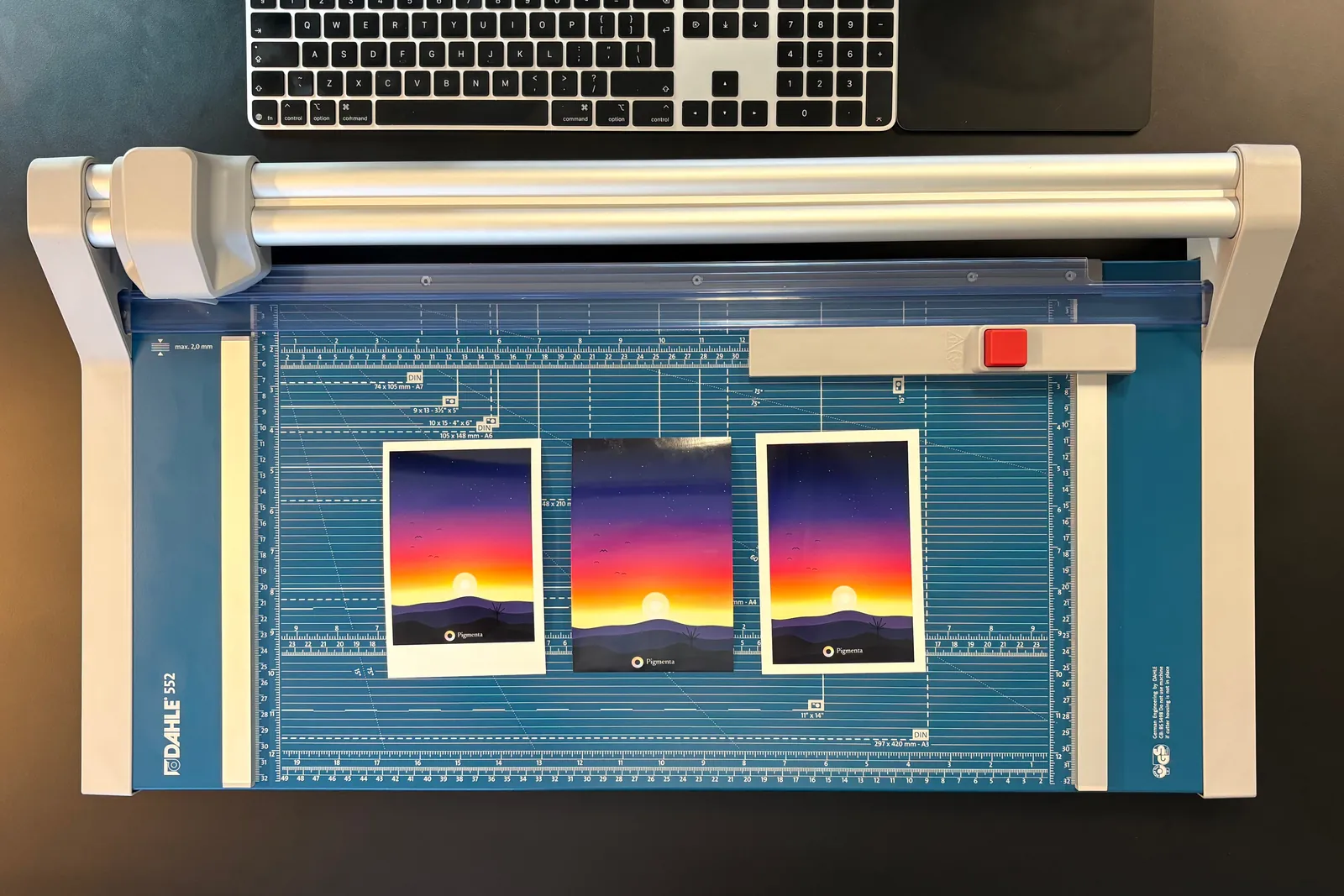
Border or borderless? When a frame line works.
Pigmenta offers two border options: none or 6 mm white. Both free. When does each fit? Here's the practical guide.
Most of the time — no border.
If in doubt, go borderless. The classic photo-card look works in most situations — album, frame, gift. Borders are useful when there's a clear reason to have one.
Photo covers the paper edge to edge.
The default. The photo reaches the paper edge. All surface area is photo content, no paper showing.
When to choose
- In an album — album pages are designed for edge-to-edge prints
- In a frame — the frame and mat provide their own border
- On a desk — small prints without a frame, in contact with other objects
- As a gift — classic photo card, doesn't assume a separate frame
- In a wedding album — compact layout
White paper line around the photo.
6 mm of white space around the whole photo — symmetric frame line. The image area is slightly smaller, but in exchange you get a built- in visual frame.
When to choose
- Wall photo without a frame — 6 mm white border replaces a frame's mat
- Gift without a frame — photo feels weightier, more "finished"
- Gallery wall — visual consistency across different photos
- Black-and-white — classic look, white border
- Content that would otherwise reach the edge — e.g. evening horizon you want to separate from the wall
The Polaroid look is its own size, not a border.
If you're after the look with a wide white strip under the photo to write on — that isn't a border you add to any size. It's a format of its own: Polaroid prints, an 8.8 × 10.7 cm sheet with a square image, white frame and a 23.5 mm caption strip already built in.
Why? Because the Polaroid look only works at the right proportions. Squeeze the same frame onto a 10×15 cm print and the image gets too small while the caption strip gets too narrow — it reads as a mistake rather than a style. A dedicated sheet gets the proportions right every time.
When to choose the Polaroid size
- Moment photos — party shots, everyday moments, not staged compositions
- Kid photos — write a name, age, date
- Fridge / pinboard — highlighted "informal" style
- Gift from a casual moment — with a caption at the bottom
- Travel photos — location and date signed
Quick reference.
| Use | Recommendation |
|---|---|
| Album, framed | None |
| Wall photo without a frame | 6 mm white |
| Gallery wall, visual consistency | 6 mm white |
| Fridge, pinboard | Polaroid size |
| Moment photos with a date | Polaroid size |
| Panorama on a wall | None or white |
| Statement photo in a frame | None |
| Kid photos (name / age) | Polaroid size |
| Classic portrait | None |
Borders shrink the image area, not the paper.
Important note: with a border, the photo content takes up less of the total paper. For example, a 10×15 cm print with a 6 mm white border has an actual image area of about 8.8 × 13.8 cm. If the photo's edges matter, go borderless.
See also: glossy vs matte, picking the right size.